
Industrialization of Self-Consumption in Buildings Spanish
To better understand what "Industrialize Self-Consumption" means, it is necessary to be clear about two essential factors:
1. Destination of supply of energy production
2. Use of the optimal Raw Material to Produce Energy ... to which should be added the following:
3. Inconsistencies in the current Remote Energy Production Model
4. Current self-consumption
Let's briefly refer to each of them:
1. Destination of supply of energy production
Buildings are the recipients of most of the energy produced:
- only residential buildings need more than 40% of the total produced (more than 65% of the citizens in Spain live in buildings)
- the great part of the rest of the production goes to the other buildings (professional, industrial, public, industrial plants)... and naturally single-family homes.
It can therefore be affirmed that if we achieve that each building and industrial plant is autonomous in producing the energy it needs, we will have solved the supply problem, additionally providing a solution to the climatic situation in the short term.
2. Use of the Optimal Raw Material to Produce Energy
One of the objectives of analyzing the energy and climate situation is focused on delving into the
use of the most appropriate raw material to promote the use of renewable energy.
The conclusion leads to indicate solar energy as the most appropriate.
Reasons:
- is the most abundant and free among renewables
- the one that provides the most energy (neither more nor less than about 2,200 kWh/m2/year in Spain),
- It does not have an expiration date (this is not the case with wind power, since according to studies in this regard, it seems that wind speed decreases progressively over time, nor does hydraulic power, since water is a scarce commodity).
Ithe easiest to obtain (increasingly efficient and cheaper solar panels)
- is the only one that facilitates energy independence from only a completely renewable source
There is an important detail to resolve:
night supply, especially in buildings (residential, professional, public, industrial and industrial plants).
It makes sense to establish a comparison with the current Electricity Production Model and the climatic situation derived from its use.
3. Inconsistencies in the current Remote Energy Production Model
The detailed analysis (*) of the process (or rather of the Model) of production of current energy shows that it has essentially not changed since commissioning march of the first plant in 1882.
(*) A summary of the analysis carried out by "αtecnología5.0" is available at its request.
A technological gap of these characteristics is incompatible with the current demands.
The logic and pragmatism of the data shows that all actions are aimed at sustaining this Model at any cost.
We cite some data extracted from the aforementioned analysis:
- Huge investments that do not actually result in obvious improvements for the environment, and even less so in the short term, which is what guarantees an improvement and reversibility of the climate situation.
- Redundancy in investments in Solar Energy: Each Solar Panel that is placed on a private roof means a superfluous solar panel (and therefore a cost) in the Solar Plant.
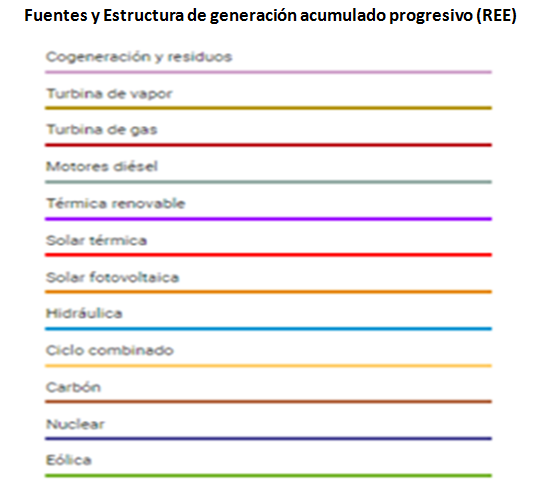
- Remote Production Model consisting of 12 different sources of production, some of them non-sustainable (renewable), complex to manage and onerous to maintain.
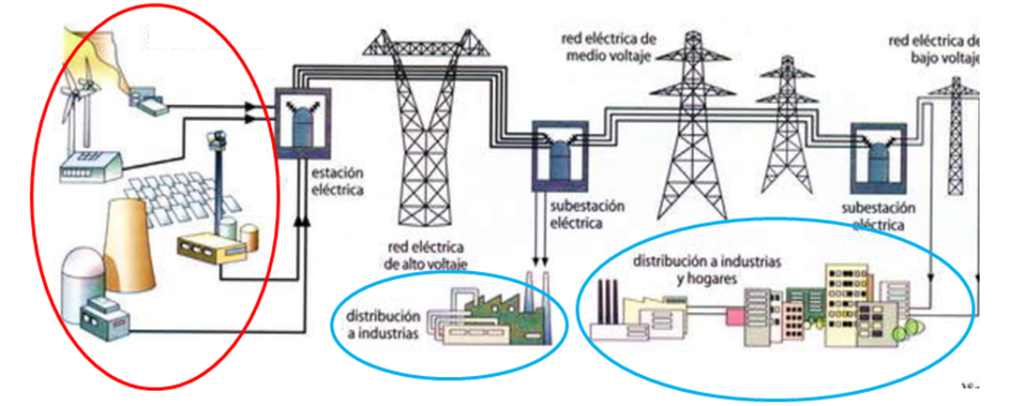
- Need for infrastructure to transport, transform and distribute the energy produced, a process that generates losses (generally higher than 11% of the total produced).
Infrastructures that are repeated for each of the facilities of the different sources of production.
The figure shows the reality of the same
- Gas (to which coal begins to be added) as the main fuel that is really the guarantor of the current supply and on which the production system essentially depends since it makes up for the deficiencies of renewables.
- The most negative, however, is that the continued use of natural gas generates "carbon locks" that delay the deployment of renewables.
- according to experts: "The use of existing and planned fossil fuel infrastructure is not compatible with the objective of not exceeding 1.5°C of warming and therefore investments in new infrastructure are risky."
- Foreign dependency: 75% in the case of Spain, the highest in Europe with an average of 60%.
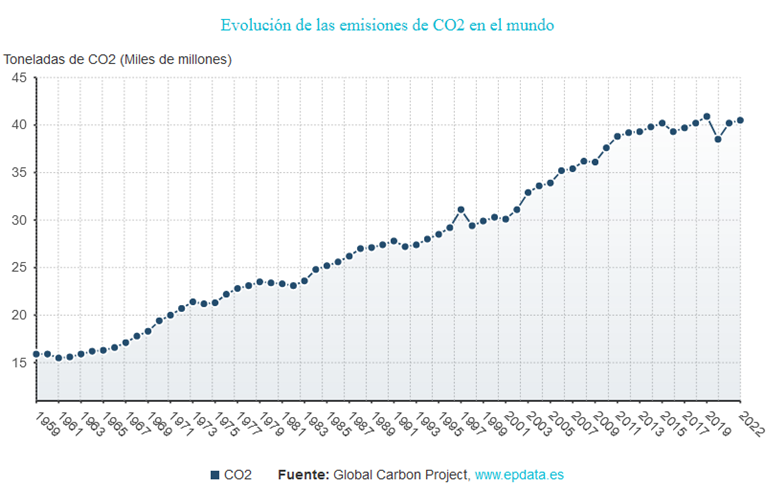
- Linear increase in CO2 emissions and significant methane leaks that had not been accounted for until now.
Significant costs in Spain derived from the maintenance of oversized and central gas installations and underused production facilities (the lowest utilization ratio of the large industrialized countries)
Costs that are included (together with those caused by transport losses) in the bill to users.
- To take into consideration is the growing rejection exerted by the population to the enormous extensions covered with solar and wind panels.
If we start from the certainty that Solar Energy is the best positioned for an on-site Production Model that guarantees energy supply, it makes sense to briefly refer to what is currently practiced, that is, Self-consumption
Reality of current self-consumption
- In recent years there have been advances in self-consumption: in Spain 5.2 GW of cumulative installed power has been reached since it was released in 2018. Some 2.4 GW corresponds to those installed in 2022
This progress does not prevent hiding that it is a minimum figure. Some data places us in the reality of self-consumption:
- Only the Community of Madrid needs about 27,000 GWh of energy, which means a huge number of years of self-consumption to cover only this Community.
Being pragmatic, self-consumption as it is currently practiced is a reality that does not solve the current situation.
- Additionally, it contributes to promoting the continuation of the current Production Model, since in general it is necessary to remain connected to the electricity and gas network.
Drawbacks of the current self-consumption
- It works only during the light time.
- Very slow development, especially in buildings.
- The energy savings that are advertised for self-consumption ranges from 50% (which is actually less in single-family homes and much lower in buildings).
- Consists essentially of solar panels. Some single-family homes install batteries to support night consumption, although their high price complicates the operation from the point of view of amortization.
Before and after you continue to pay the electricity bill and the gas bill
• The buildings place only solar panels since there is no reserve equipment sized for high consumption.
Conclusion:
An eminently manual self-consumption process:
- does not solve current supply needs,
- does not solve energy dependency,
- It does not reduce CO2 and Methane levels with the haste required by experts.
The situation is identical to if the vehicles were currently manufactured manually instead of in automated factories as is the case.
So it is necessary to establish an industrialized process
Self-consumption industrialization
The industrialization of a Self-consumption aimed at the introduction of a Model of Completely Autonomous Facilities for Electric Power Generation, especially focused on Buildings, is based on the following parameters:
• Essential use of solar energy: it is the only one that does not need to build or maintain facilities for transportation, transformation, and distribution.
• Have the appropriate reserve equipment to store the necessary energy to guarantee the autonomy of the buildings throughout the day.
"atecnologia" has such equipment. We assemble and size them in Spain
The most important thing however is:
- generate the Engineering that allows the development of industrial procedures to optimize the processes and procedures for the manufacture of components, assembly structures, thus minimizing on-site actions.
- design and have the necessary infrastructure to automate manufacturing, simplify logistics and assembly
Industrializing a process means large-scale implementation of Autonomous Energy Production Facilities in Buildings of all kinds. For this, it is essential to access quickly and efficiently, especially to Residential Buildings.
- In this sense, we have developed a procedure that allows us to reach de facto all the buildings in the country, in a "natural" way and without delays.
A Model based on these parameters is the only one that:
- guarantees energy supply at present and in the near future without dependence on third countries
- manages to drastically reduce emissions in the short term
- provides (for the first time) economic benefits to families and companies, freeing them from the current life bill, providing peace of mind to the supply
- guarantees private management, independent from politicians and large electricity companies and investments for installations of doubtful sustainability.
This is the basis on which the Autonomous Energy Production Model developed by "αtecnología" is based.
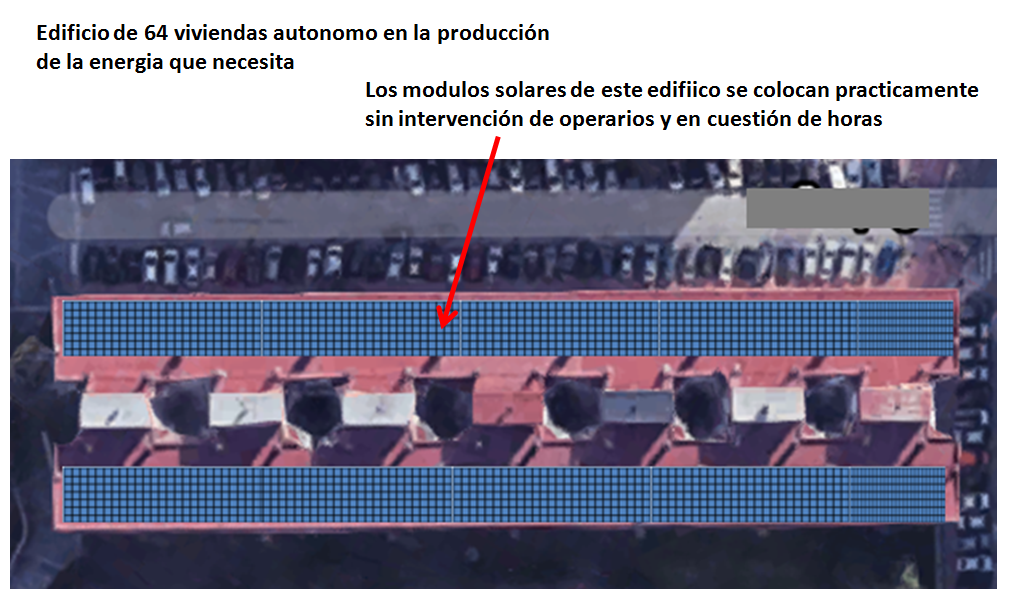
With this, we were able to equip an entire building with 400 solar modules in less time than those needed for a single-family home.
Field operations are drastically reduced:
- Placing around 400 solar panels on a building takes less time than fixing a few on the roof of a single-family home, with the enormous difference that in the first case (building) it is not necessary to carry out work at heights (especially not without risks). on pitched roofs) or component interconnection.
A significant aspect is that, in addition to simplifying operations, most of the tasks currently carried out by operators at height are eliminated, and with it the risk that this entails.
Our engineering has developed what we call "Assembly Platforms" that automate the manufacturing and assembly process on a large scale, with hardly any human intervention, optimizing and therefore minimizing on-site actions, gaining safety, assembly quality, extraordinarily minimizing the field operations time.
- These procedures make it possible to equip more than 9,000 buildings in less than a year, working in different areas.
We urge you to contact us for more details on the subject.
© Derechos de autor. Todos los derechos reservados.
Necesitamos su consentimiento para cargar las traducciones
Utilizamos un servicio de terceros para traducir el contenido del sitio web que puede recopilar datos sobre su actividad. Por favor, revise los detalles y acepte el servicio para ver las traducciones.