Our company Spanish
Among the greatest desires of each citizen, the following could be highlighted:
- health,
- family,
- a paid activity,
- home, vehicle... and have an energy supply.
It is in the last mentioned (housing, vehicle, energy) where "αtecnologia5.0" intervenes, contributing to their becoming accessible (or at least more accessible) realities as a necessary complement to the most important ones, those mentioned in the first place.
The evolution of technology marks the future of all industrial sectors, in turn shaping practically all aspects of society.
The so-called “Industrial Revolutions” (the last known as “Industrial Models”) clearly express the reality of how the “present – future” relationship “shrinks” or approaches depending on the available technology.
This reality is shown in the following graph:
Distances in time of more than two centuries with the 1st and 2nd Industrial Revolution give way to only a few years:
- 10 years between the 2nd and 3rd
- Only 4 years separate the 3rd from the 4th (known as "Model 4.0"), the latter already practically overlapping with the 5th).
Each one of them is obsolete, if outdated in relation to the processes and technical procedures that the new Models introduce.
Certain professional and industrial sectors adopt more consistently than others the advantages and facilities that technological progress entails.
Current significant examples due to their importance illustrate the foregoing: We refer to the following sectors:
1. Electric Power Production
2. Home building
3. Vehicle Production
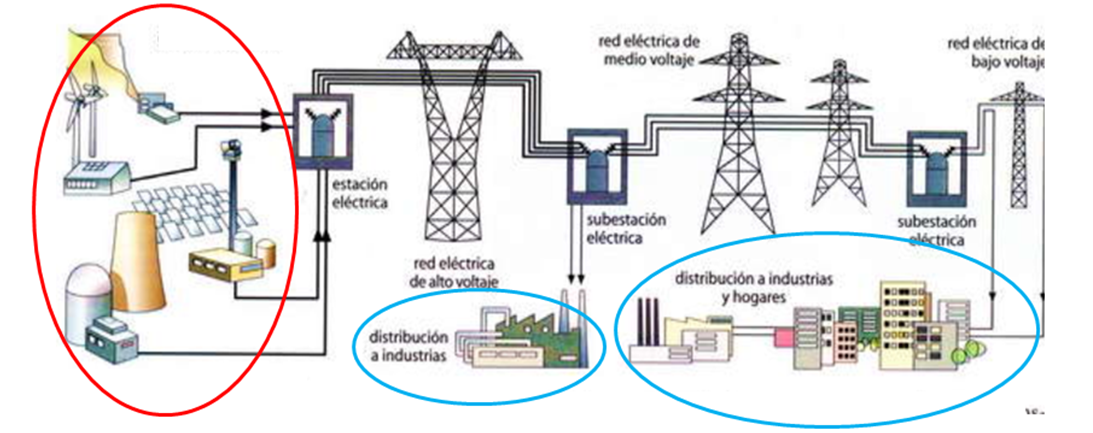
1. Electric Power Production
The origins date back to the first Industrial Revolution.
Year 1882: commissioning of the first power station)
Situation in the 21st century
In the 21st century, the process is practically similar to the previous century: remote production, transport, transformation and distribution of energy together with significant losses, a complex management derived from having to deal with 12 different sources of production, each with the corresponding infrastructures.
The evolution of technology is hardly reflected in the processes (apart naturally from the equipment and the computerization of the systems).
Beginning of the 20th century <---> Similar procedures <---> Beginning of the 21st century
Current results
Significant infrastructure costs (transportation, transformation and distribution, which additionally generate energy losses), costs that are reflected in the bill to users:
- Facilities some oversized (as is the case of gas) and underused (energy production)
- complex and inefficient management (despite the computer systems used) partly due to the numerous production sources involved -12 different ones-).
- Major investments that fail to reduce greenhouse gas emissions (essentially CO2 and Methane),
- Production system that does not guarantee supply and has caused the climate crisis
- Foreign dependency (75% in the case of Spain, 60% on average in Europe).
- high energy prices for citizens and businesses
The gap and its incompatibility with the current demands for sustainability, supply and reducing CO2 and methane emissions are evident.
2. Construction of Houses... and Cars
Housing and car
These are, with health and a job, the wishes of the majority of citizens
More than a century ago, a house and a car had a great similarity: They cost a fortune... in fact, it was just status for certain social segments
Both products were built manually, which resulted in:
- long waiting time
- high costs
- dubious quality derived from human intervention
Let us briefly observe the evolution of each of these sectors from then to the present moment.
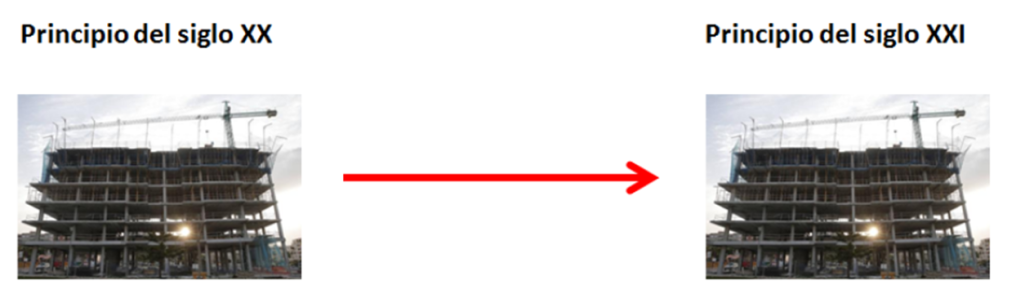
Housing construction in the 21st century.
Methods and processes have barely evolved.
It is built practically like decades ago, which is reflected in reality by:
- Few houses built that do not meet the demand,
- High costs that are not affordable for many citizens, especially young people with the desire to become emancipated
- long waiting time,
- Excessive intervention of intermediaries
- Considerable manpower that is also scarce.
- Situation that does not guarantee compliance with deadlines or budgets
- Quality in many cases doubtful: It is difficult to certify the real quality in each of the phases of a construction based essentially on manual processes. In general, a certificate is issued at the end of the work
1. Vehicle Production
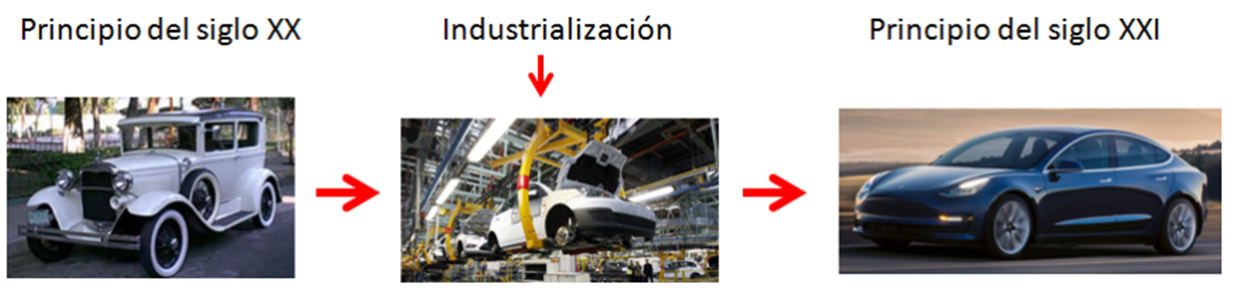
In 1886 the first automobiles began to be manufactured. Eminently manual manufacturing which implied few units, high prices, questionable quality
The introduction of the assembly line at the turn of the last century completely changed the landscape for the automobile.
The industrialization of the different manufacturing processes was the differentiating function, as reflected in the figure
Automobile Industrialization
The car stopped being built to start an industrial manufacturing process
Situation in the 21st century.
The evolution of the production process in this sector has developed in accordance with the advances technology until reaching the current production system based on automated processes (in accordance with the "Model 4.0").
The advantages of the automation procedures or what is the same of the optimization of the production are evident:
- Costs reduction
- Delivery time in few weeks
- Increased quality and reliability
- Vehicles accessible to practically all segments of the population
The (huge) difference lies in the optimization of production by introducing automated processes:
Energy Production and Housing Construction:
- Hardly any changes in the process of producing energy or building houses (advances have occurred in design systems, in the materials used and the introduction of prefabricated elements)
Car:
- Complete industrialization of the sector with known results: Only one factory produces more than a thousand units/day, short delivery time, affordable prices, good quality
Conclusion
The enormous difference between production processes lies in their industrialization (read optimization) by adapting updated technological advances. This is the essential aspect that determines the results.
"αtechnologia" in this context
"atecnologia" engineers have extensive experience in optimized processes and automation, including "Model 4.0" procedures. We cite some examples in which they have participated:
- Expansion of the process calculation center to increase production at the Opel vehicle factory in Zaragoza.
- Automation of the manufacture of the boat hull in the shipyard of the Balenciaga company in Zumaya (Guipúzcoa). First chain that automates discontinuous processes (that is, manufacturing different parts in the same chain)
- Participation in different automation projects for Navantia (Cadiz) and Airbus (Puerto de Santa María, Seville, Madrid)
"atecnologia" is the first company that (except for errors or omissions) provides solutions to essential sectors for society such as Energy Production and Housing Construction.
The solutions it has developed are based on current technological criteria.
The results are reflected in the following projects:
- Energy Production: Self-Consumption Industrialization
- Development of Engineering and infrastructure that allows the installation of Autonomous Energy Production Systems independent of the electricity and gas network
Result: Energy independence. Drastic reduction of CO2 and Methane See Page: Industrialization of Self-Supply"
- Housing Construction: Optimization of the Construction of Residential Buildings, Flexible Housing
- Residential buildings built with procedures adapted from robotic processes. - Flexible Homes that make optimal use of the land (a flexible home of 53 m2 has more habitability than a conventional one of 110 m2.
Result: A 45-dwelling building built with our procedures is ready in about 4 - 5 months (usually the delivery time ranges from around 18 months, documenting the quality of each of the construction phases See Page: "Flexible Housing"

© Derechos de autor. Todos los derechos reservados.
Necesitamos su consentimiento para cargar las traducciones
Utilizamos un servicio de terceros para traducir el contenido del sitio web que puede recopilar datos sobre su actividad. Por favor, revise los detalles y acepte el servicio para ver las traducciones.